
RTM and light RTM (LRTM)
RTM (resin transfer moulding) is a process in which dry fibres – mats, fabrics or preforms – are closed in a mould and resin is then injected into it. In light RTM (LRTM) we work with closed composite or aluminium moulds: the cavity is vented with vacuum and the resin is fed from a pressure pot at an overpressure of usually 1–4 bar.
Key parameters
| Typical volume | LRTM: approx. 100–7,000 pcs/year; RTM: up to tens of thousands |
| Cycle time | from about fifteen minutes to approx. 1.5 h |
| Mould | closed; in LRTM composite or aluminium |
| Resin injection | from a pressure pot, usually 1–4 bar in LRTM |
| Vacuum | vents the mould cavity before and during injection |
| Surface | both sides from the mould, gelcoat possible |
Typical, indicative values – they depend on the geometry, material and requirements.
What you can order from us
- Housings, covers and panels
- Structural parts with repeatable wall thickness and mass
- Parts with two finished surfaces, also with gelcoat
| Materials | carbon or glass mats, fabrics and preforms; epoxy and vinyl ester resins |
| Typical volumes | LRTM approx. 100–7,000 pcs/year, RTM up to tens of thousands |
| At our plant | closed composite or aluminium moulds, injection from a pressure pot |
| For a quote send | a 3D model or drawing – or a description and sketch, the requirements and annual quantity |
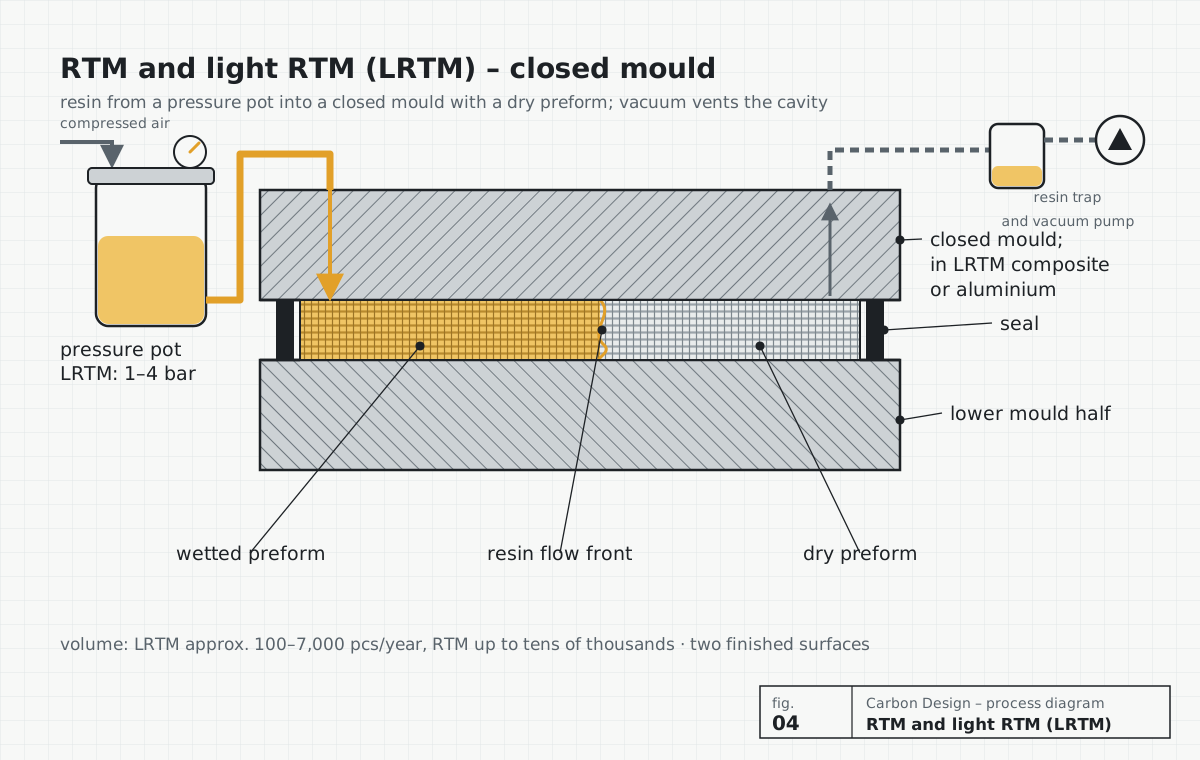
RTM and light RTM – how we work
| Variant | Mould and injection | Typical use |
|---|---|---|
| Light RTM (LRTM) | Closed composite or aluminium mould; vacuum vents the cavity, resin from a pressure pot at usually 1–4 bar | Covers, housings, panels and structural parts in medium series |
| RTM | Two rigid mould halves, resin injection at higher pressure | Carbon and glass structural parts, frames, larger series |
A pressure pot is a pressurised resin tank: compressed air pushes the resin into the mould at a constant, controlled overpressure. Together with vacuum in the cavity this shortens the filling time and wets out denser preforms than vacuum alone, as in infusion.
Composite and aluminium moulds are cheaper and quicker to make than steel ones, so LRTM pays off already in medium series. An aluminium mould conducts heat better and lasts longer; a composite one is cheaper to start with.
RTM gives repeatable wall thickness and part mass, because the geometry is set by the gap between the mould halves, not by manual consolidation. It needs well-designed preforms and injection points – which we prepare in flow analyses.
When to choose it
- Both surfaces of the part must be finished and repeatable
- A series from about a hundred parts a year – LRTM in composite or aluminium moulds
- Repeatable thickness, mass and fibre content matter
- You want to cut styrene emissions and manual work compared with contact lamination
When another process is better
- One-off, very large parts – vacuum infusion is cheaper
- The highest aerospace laminate quality is required – consider autoclave or RAT
- Complex shapes with ribs and inserts in large series – consider forged carbon
How we introduce RTM and LRTM
- Resin flow analysis: injection and vent points, filling time.
- Design of preforms and cut patterns, choice of materials and resin.
- Design of a closed mould – composite or aluminium in LRTM – with seals, vacuum and injection ports and temperature control, in NX Mold Wizard.
- Trial batch: setting the pressure pot overpressure, vacuum level and temperature; checking filling, porosity and wall thickness.
- Cycle optimisation and documentation – production at our plant or transfer to the customer’s plant.
Questions and answers
How is light RTM different from RTM?
In both, resin is injected into a closed mould with dry fibres. In light RTM we use lighter, cheaper composite or aluminium moulds, vent the cavity with vacuum and feed the resin from a pressure pot at a small overpressure, usually 1–4 bar. RTM in rigid moulds allows higher injection pressure and larger series.
Why vacuum and a pressure pot in LRTM?
Vacuum removes air from the cavity and the preform before the resin reaches them, which limits porosity. The pressure pot feeds the resin at a controlled overpressure, usually 1–4 bar, so the mould fills faster and more reliably than with vacuum alone.
What moulds do you use for LRTM?
Closed composite or aluminium moulds. The choice depends on the series, the surface requirements and the curing temperature – aluminium conducts heat better and lasts longer, composite is cheaper to start with.
What fibre content does RTM reach?
With dry carbon fibre preforms the fibre volume fraction is usually 50–60%. With glass mats it is lower, which is enough for covers and housings.
Do you introduce RTM and LRTM at customer plants?
Yes. We design the moulds and the process, start up production at your plant, train operators and hand over the process documentation.
External data sources: BFG International – LRTM.
Other technologies
Need help choosing?
Send us a description of the part and the planned quantity – we will propose the process and explain why.
Have a drawing or just an idea? We will tell you how to make it.
Tell us what the part has to do, how many you need and what the requirements are. We will reply with a proposed process, material and next steps – with no obligation, under NDA if needed.