
Vacuum infusion (VARTM)
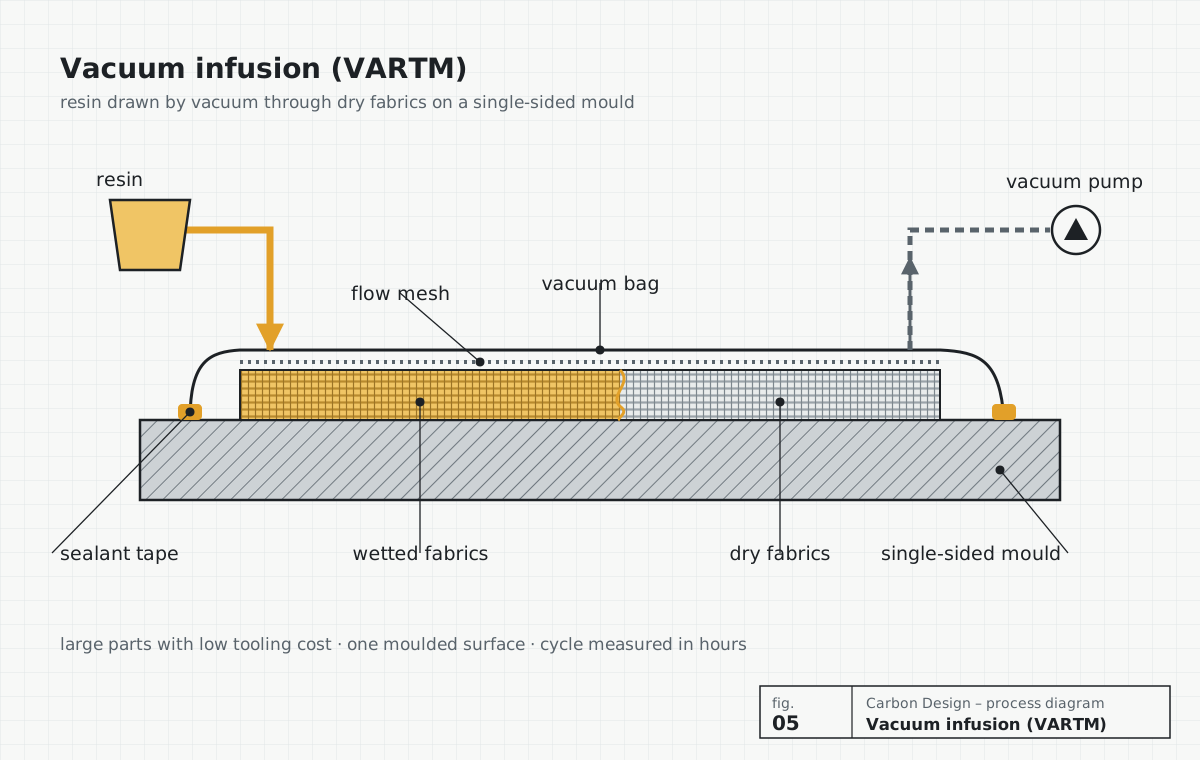
Vacuum infusion (VARTM, vacuum assisted resin transfer moulding) is a process in which dry fabrics are laid on a single-sided mould and covered with a vacuum bag, and resin drawn in by vacuum wets out the whole stack at once. We use it for large carbon and glass fibre parts.
Key parameters
| Typical volume | one-offs to a few hundred pcs/year |
| Cycle time | hours (layup, infusion, cure) |
| Part size | from a few tens of centimetres to tens of metres |
| Surface | one side from the mould |
| Mould cost | low – single-sided mould |
Typical, indicative values – they depend on the geometry, material and requirements.
What you can order from us
- Large panels, covers and shells
- Large carbon parts in small series
- An intermediate step before series production in RTM
| Materials | carbon and glass fabrics, sandwich cores |
| Typical volumes | one-offs to a few hundred pcs/year |
| At our plant | single-sided moulds, post-curing ovens |
| For a quote send | a 3D model or drawing – or a description and sketch, the requirements and annual quantity |
Where infusion has the edge
Infusion needs neither an autoclave nor a press, and the mould is single-sided, so tooling cost grows slowly with part size. That is why yacht hulls, wind turbine blades and large covers are made this way. An example of scale: the Gdańsk shipyard Sunreef Yachts infused a 43 m hull with 1,700 m² of laminate in a single process.
In our projects we use infusion for large carbon parts where the mass-to-cost ratio matters, and as an intermediate step before starting series production in RTM.
When to choose it
- The part is large and the series is small
- Low mould cost and short mould lead time matter
- You need a good-quality carbon fibre laminate without an autoclave
When another process is better
- Both sides of the part must be finished – choose RTM or LRTM
- The series runs to thousands – layup time will be too long
- Aerospace quality with porosity below 1% is required – autoclave
How we run infusion
- Laminate and infusion strategy design: channels, inlet and vent points.
- Mould preparation, layup of dry fabrics, cores and process layers.
- Bagging, leak test (thermal and ultrasonic cameras), resin infusion.
- Curing and post-curing at elevated temperature.
- Demoulding, machining and inspection: thickness measurement, wet-out assessment, microscope cross-section.
Questions and answers
Does infusion give good laminate quality?
Yes – with a well-designed infusion strategy the laminate is evenly wetted and the fibre content is higher than in hand lamination. For the highest-grade aerospace applications an autoclave is still used.
What are the limits of infusion?
Only one side of the part copies the mould, and the cycle takes hours. For series of thousands of parts RTM, compression moulding or forged carbon are better.
External data sources: Yacht.de – Sunreef 43M Eco, infusion record.
Other technologies
Need help choosing?
Send us a description of the part and the planned quantity – we will propose the process and explain why.
Have a drawing or just an idea? We will tell you how to make it.
Tell us what the part has to do, how many you need and what the requirements are. We will reply with a proposed process, material and next steps – with no obligation, under NDA if needed.