
with partners
Filament winding
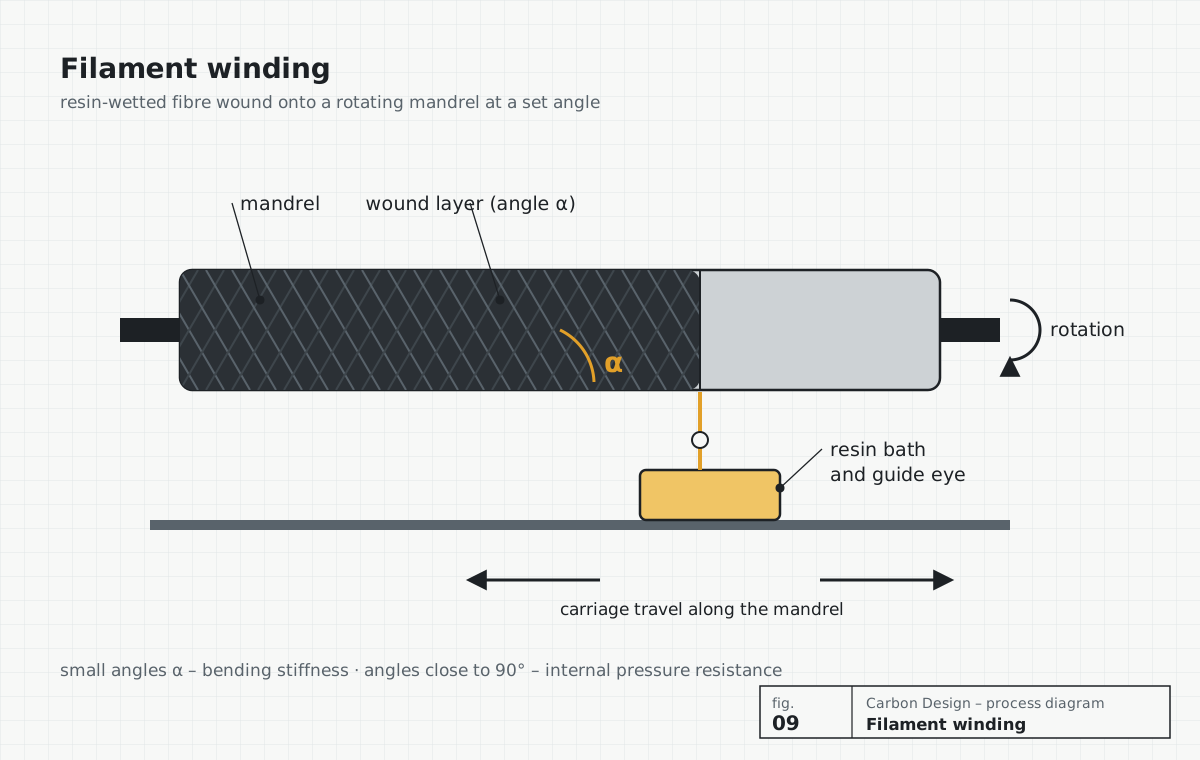
Filament winding is a process in which continuous fibre wetted with resin is laid on a rotating mandrel at a programmed angle. The winding angle decides stiffness and strength: small angles strengthen bending, angles close to 90° resist internal pressure. Tubes, shafts, profiles and tanks are made this way.
Key parameters
| Typical volume | from tens to tens of thousands of pcs/year |
| Shapes | rotational and similar, profiles |
| Winding angles | programmed, usually approx. 10–90° |
| Surface | smooth inside (mandrel) |
| Fibres | carbon, glass, aramid, basalt |
| Production | with partners, under Carbon Design supervision |
Typical, indicative values – they depend on the geometry, material and requirements.
What we make with partners
- Tubes, shafts and profiles
- Pressure vessels
- Profiles for structures joined with forged carbon parts
| Materials | carbon, glass, aramid and basalt fibre |
| Typical volumes | from tens to tens of thousands of pcs/year |
| Production | at partners under our supervision |
| For a quote send | a 3D model or drawing – or a description and sketch, the requirements and annual quantity |
| Example | UL-CompPro: ultralight helicopter skids |
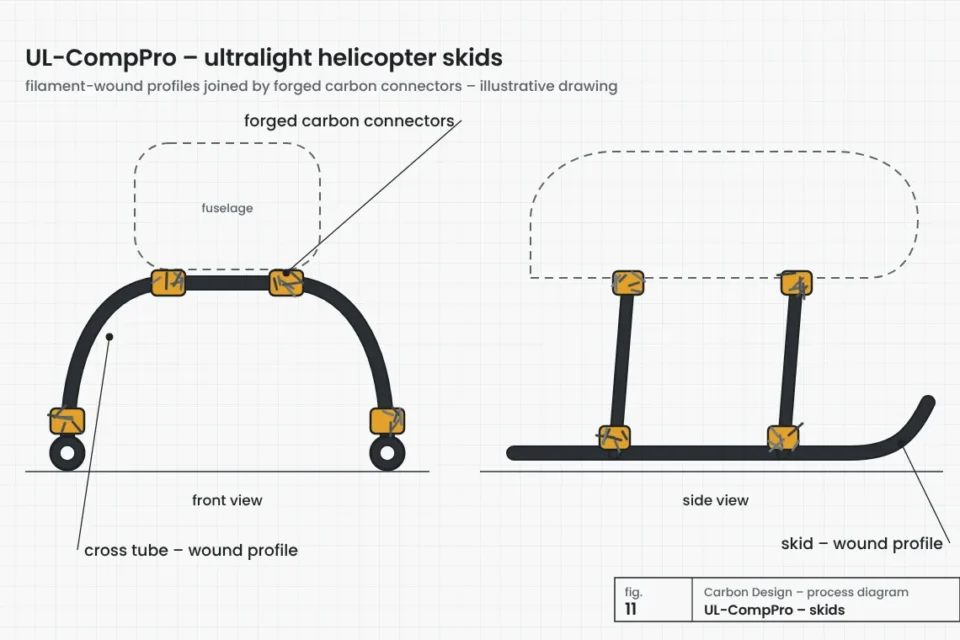
Wound profiles in the UL-CompPro project
In the UL-CompPro project, run with East 4D Carbon Technology GmbH in the AMULET (1st call) programme, we are developing ultralight helicopter skids. The structure combines filament-wound profiles with forged carbon connectors – each element is made with the process best suited to its function.
We have also developed a method for carbon profiles with a variable outer shape and a variable section. When a profile does not have a constant diameter, we choose the process for the geometry and loads – filament winding is one of the options.
When to choose it
- The part is a tube, shaft, profile or tank
- You need precisely designed fibre angles for the loads
- Repeatability and automation matter
When another process is better
- The shape has concave areas and cannot be wound – RTM, compression moulding or forged carbon
- A smooth moulded outer surface is required – extra finishing is needed
Questions and answers
Do you make variable-section profiles?
Yes. We have developed a method for carbon profiles with a variable outer shape and section. We choose the process for the geometry and loads of the profile.
What parts are usually filament wound?
Drive tubes and shafts, arms and beams, structural profiles, covers and pressure vessels, including hydrogen tanks.
Related projects
 UL-CompPro: ultralight helicopter skids
An AMULET (1st call) project with East 4D Carbon Technology GmbH: skids made of filament-wound profiles and forged carbon connectors.
Other technologies
Need help choosing?
Send us a description of the part and the planned quantity – we will propose the process and explain why.
Have a drawing or just an idea? We will tell you how to make it.
Tell us what the part has to do, how many you need and what the requirements are. We will reply with a proposed process, material and next steps – with no obligation, under NDA if needed.