
with partners
Autoclave
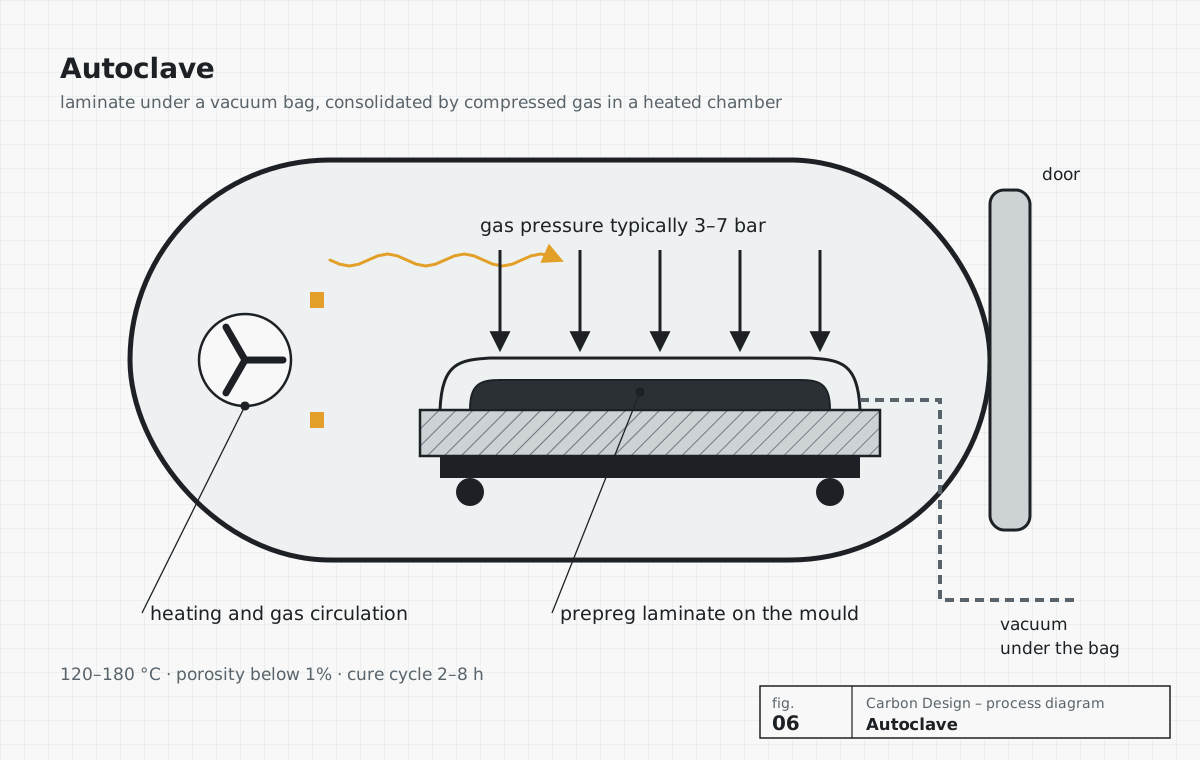
Prepreg is a fibre fabric or tape pre-impregnated with resin. The plies are laid on a mould to a ply book, bagged under vacuum and cured in an autoclave – under pressure and at elevated temperature. This gives the lowest-porosity laminate with the highest properties.
Key parameters
| Typical volume | one-offs to approx. 2,000 pcs/year |
| Pressure | typically 3–7 bar (up to approx. 10 bar) |
| Cure temperature | 120–180 °C |
| Cure cycle | usually 2–8 h |
| Porosity | below 1% |
| Fibre content | approx. 55–65 vol% |
| Production | with partners, under Carbon Design supervision |
Typical, indicative values – they depend on the geometry, material and requirements.
What we make with partners
- Aerospace and highly loaded prepreg parts
- Visible parts with a class A surface
| Materials | carbon, glass and aramid prepregs |
| Typical volumes | one-offs to approx. 2,000 pcs/year |
| Production | curing at partners; we do the laminate design, the mould and quality control ourselves |
| For a quote send | a 3D model or drawing – or a description and sketch, the requirements and annual quantity |
When an autoclave is the best choice
The autoclave is the standard for critical aerospace parts: it gives full control of pressure and temperature, repeatability and porosity below 1%. In premium automotive it is used for class A panels – for example the Italian HP Composites cures body panels from Hexcel surface prepreg at 120–180 °C.
Prepreg lets us design the laminate directionally: we lay the plies along the load axes (0°, ±45°, 90°), so the part has high stiffness at minimum mass. We make moulds from composite, aluminium or steel, depending on the series and dimensional requirements. Curing takes place at partners; we do the laminate design, the mould and the quality control ourselves.
When to choose it
- The part works under high load and must have the highest properties
- Porosity below 1% and documented repeatability are required
- Visible carbon or a class A surface
- A series from a prototype to about two thousand parts a year
When another process is better
- The series runs to tens of thousands – consider compression moulding or forged carbon
- The part does not fit an autoclave, or you want to avoid pressurising a whole chamber – RAT, OOA or infusion
- The budget does not justify an hours-long cycle – consider PCM or OOA
Step by step
- Laminate design and ply book based on FEM analysis.
- Mould manufacture and mould surface preparation.
- Cutting the prepreg plies and laying them to the ply book.
- Vacuum bagging, leak check (thermal and ultrasonic cameras), autoclave cure to the temperature and pressure profile.
- Edge trimming, bonding, painting and inspection: 3D scan and microscope cross-section.
Questions and answers
Why does an autoclave give a better laminate than a vacuum bag alone?
A vacuum bag consolidates the laminate with at most atmospheric pressure (about 1 bar). An autoclave adds several bar of overpressure, which collapses gas voids and raises the fibre content. The result is porosity below 1% and higher strength.
Does an autoclave pay off for series?
Up to about two thousand parts a year it usually does, especially for visible or highly loaded parts. Above that, PCM, SQRTM or forged carbon with a cycle of minutes are worth considering.
External data sources: Design News – Hexcel and HP Composites.
Other technologies
Need help choosing?
Send us a description of the part and the planned quantity – we will propose the process and explain why.
Have a drawing or just an idea? We will tell you how to make it.
Tell us what the part has to do, how many you need and what the requirements are. We will reply with a proposed process, material and next steps – with no obligation, under NDA if needed.