
Compression moulding: PCM, WCM, SQRTM
Compression moulding forms a composite in a closed, heated mould in a press. We combine several variants: prepreg compression moulding (PCM), wet compression moulding of fabrics with resin (WCM), SQRTM and balanced pressure fluid moulding (BPFM). What they share: two finished surfaces and a short cycle.
Key parameters
| Typical volume | from 1,000 to tens of thousands of pcs/year |
| Cycle time | usually 3–15 min (fast-curing resins) |
| Surface | both sides from the mould |
| Mould | steel or aluminium, heated |
| Presses at our plant | 160 t and 40 t hydraulic |
| Charge | prepreg, dry fabrics + resin, C-SMC |
Typical, indicative values – they depend on the geometry, material and requirements.
What you can order from us
- Thin-walled panels and lids
- Covers and housings with two finished surfaces
- Visible carbon parts for painting
| Materials | prepregs, dry fabrics with resin, C-SMC |
| Typical volumes | from approx. 1,000 to tens of thousands of pcs/year |
| At our plant | 160 t and 40 t hydraulic presses |
| For a quote send | a 3D model or drawing – or a description and sketch, the requirements and annual quantity |
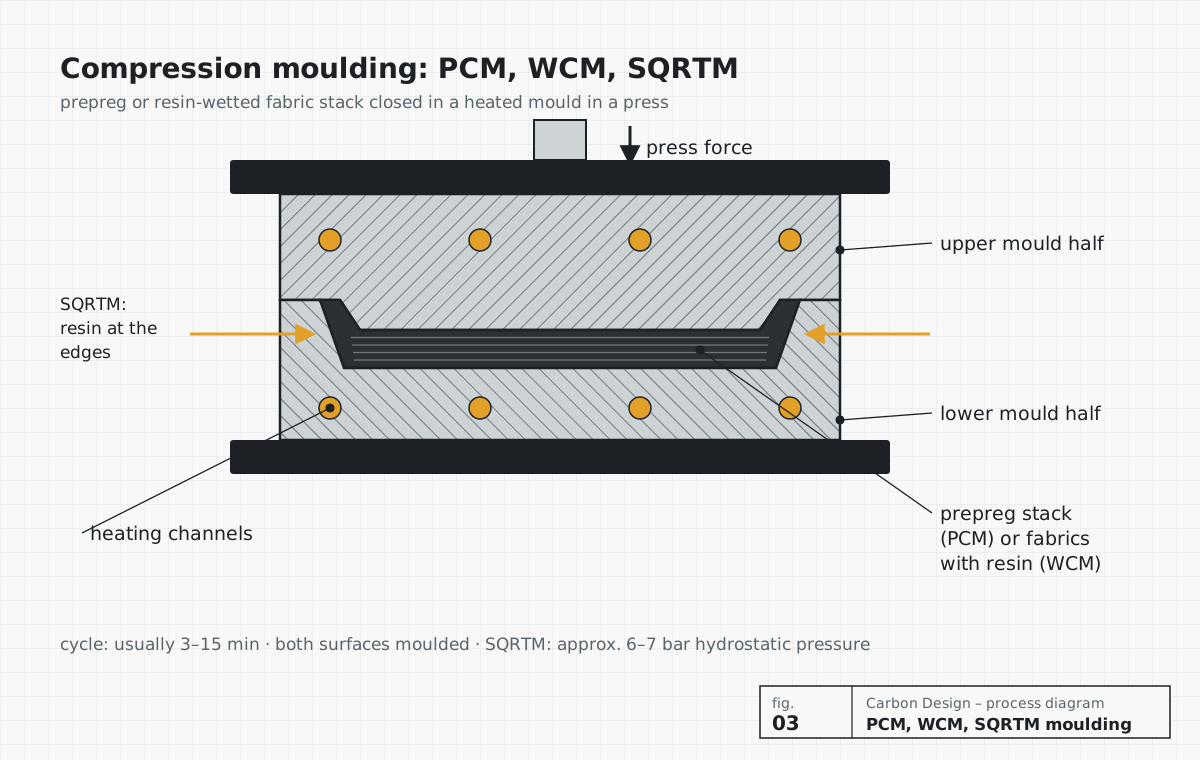
The compression moulding variants we use
| Process | How it works | When |
|---|---|---|
| PCM – prepreg compression moulding | A prepreg stack (often with a fast-curing resin) pressed in a hot mould. | Thin-walled panels and lids in medium series, when continuous-fibre laminate quality matters. |
| WCM – wet compression moulding | Dry fabrics wetted with resin just before the mould closes, then pressed. | Larger series of flat and slightly 3D parts, lower material cost than prepreg. |
| SQRTM – same qualified RTM | Prepreg in a closed mould; resin injected at the edges holds a hydrostatic pressure of approx. 6–7 bar. | Autoclave-quality parts without an autoclave – porosity below 2%. |
| BPFM – balanced pressure fluid moulding | Pressure transferred to the laminate by a fluid, evenly over the whole surface. | Large and complex surfaces where a conventional press gives uneven pressure. |
| C-SMC / C-BMC | Chopped fibre in sheets or bulk compound, flowing in the mould. | Complex 3D shapes – see forged carbon. |
When to choose it
- A series from a thousand parts a year and a short cycle
- Both sides of the part must be finished when it leaves the mould
- Repeatable thickness and mass matter
- You want continuous-fibre laminate quality without an autoclave
When another process is better
- The series is one-offs – a press mould will not pay off
- The part is very large – infusion or light RTM is better
- The shape has undercuts that cannot be released from a two-part mould
How we set up a compression moulding process
- Choice of process variant and material for the requirements and volume.
- Part design for a closed mould: draft angles, edges, pinch-off zones.
- Design of a heated, temperature-controlled mould in NX Mold Wizard; manufacture with a toolmaker.
- For chopped-fibre materials (C-SMC, BMC) – filling and fibre orientation simulation in Moldex3D with the Fiber module.
- Charge development: ply book cut patterns or compound and its placement in the mould.
- Trial batch and optimisation: temperature profile, pressure curve, cycle time.
- Process documentation and series production with every batch inspected.
Questions and answers
How is PCM different from an autoclave?
In an autoclave a vacuum bag and gas pressure consolidate the laminate, and the cycle takes hours. In PCM two mould halves in a press consolidate the prepreg, and fast-curing resins cut the cycle to minutes. PCM needs a more expensive mould, so it pays off in larger series.
What is SQRTM?
SQRTM (same qualified resin transfer moulding) is a process in which prepreg cures in a closed mould while a small amount of resin injected at the laminate edges holds hydrostatic pressure. It gives near-autoclave quality without an autoclave.
Can compression-moulded parts have visible carbon?
Yes. In PCM and WCM both surfaces copy the mould. On visible parts we use suitable surface plies and painting.
External data sources: Wikipedia – Out of autoclave composite manufacturing.
Other technologies
Need help choosing?
Send us a description of the part and the planned quantity – we will propose the process and explain why.
Have a drawing or just an idea? We will tell you how to make it.
Tell us what the part has to do, how many you need and what the requirements are. We will reply with a proposed process, material and next steps – with no obligation, under NDA if needed.