
with partners
Pultrusion
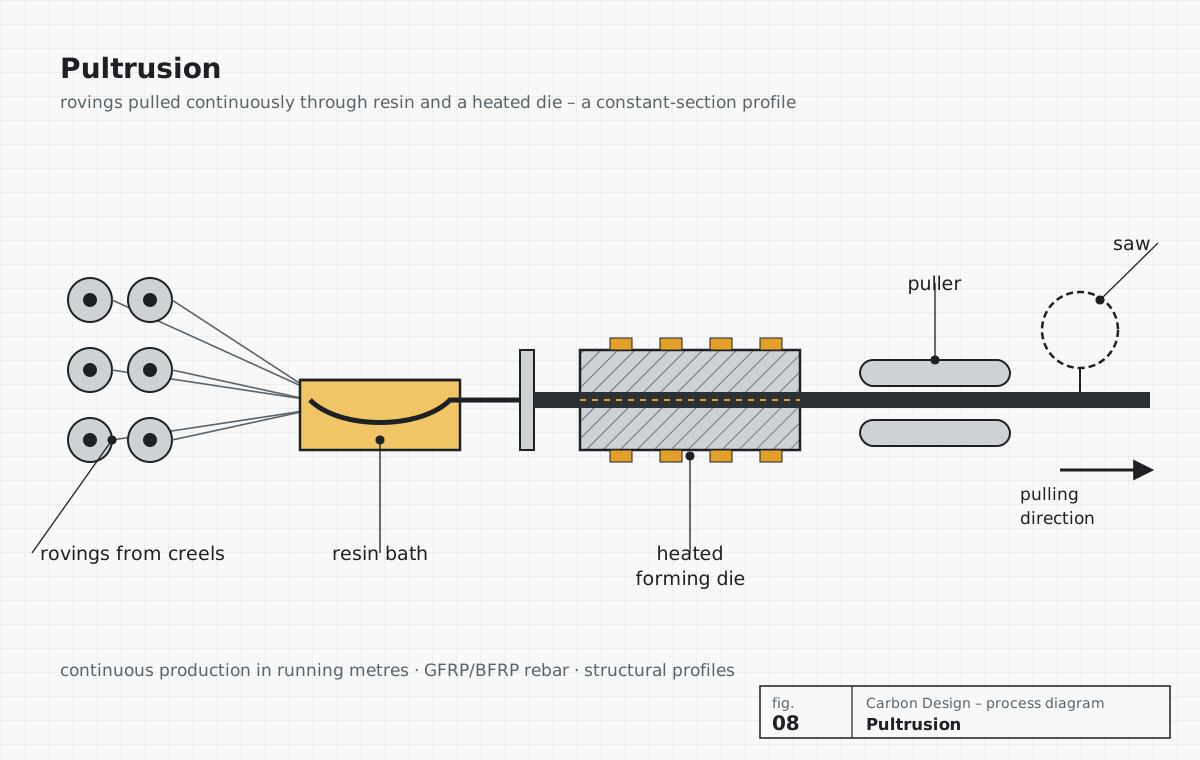
Pultrusion is a continuous process in which fibre bundles (rovings) are pulled through a resin bath or injection chamber and a heated forming die. The result is a profile with a constant section – a rod, tube or channel – cut to length. We have started up and optimised a line for composite rebar.
Key parameters
| Production | continuous, in running metres |
| Section | constant along the length |
| Fibres | glass, basalt, carbon |
| Fibre content | high, fibres along the profile axis |
| Typical products | rebar, structural profiles |
| Production | with partners, under Carbon Design supervision |
Typical, indicative values – they depend on the geometry, material and requirements.
What we make with partners
- Composite rebar for concrete
- Constant-section structural profiles
- Start-up and optimisation of lines at customer plants
| Materials | glass, basalt and carbon rovings; vinyl ester and epoxy resins |
| Typical volumes | continuous production, in running metres |
| Production | at partners or on the customer’s line – we run the parameters and quality |
| For a quote send | a 3D model or drawing – or a description and sketch, the requirements and annual quantity |
| Example | Pultrusion line for composite rebar |
Composite rebar for concrete
Glass or basalt fibre bars do not corrode, are several times lighter than steel and do not conduct electricity. They work well in structures exposed to salt and moisture and where steel is a problem – e.g. near equipment sensitive to magnetic fields.
When starting up a line we work on process stability: fibre wet-out, die temperature profile, pulling speed, rib winding and quality control of the finished bar. The goal is a constant section, full cure and repeatable bond to concrete.
When to choose it
- The product has a constant section and a long length
- Continuous production at a low cost per metre is needed
- Corrosion resistance and low mass matter
When another process is better
- The section changes along the length – consider filament winding or RTM
- The part is short and three-dimensional – consider forged carbon or compression moulding
Questions and answers
Do you help start up a pultrusion line at a customer’s plant?
Yes. We have started up and optimised a composite rebar line – from process parameters to quality control and documentation.
What fibres are composite bars made of?
Most often glass (GFRP) and basalt (BFRP), less often carbon (CFRP), with vinyl ester or epoxy resins.
Related projects
 Start-up of a pultrusion line for composite concrete rebar
Start-up and optimisation of a production line for composite rebar.
Other technologies
Need help choosing?
Send us a description of the part and the planned quantity – we will propose the process and explain why.
Have a drawing or just an idea? We will tell you how to make it.
Tell us what the part has to do, how many you need and what the requirements are. We will reply with a proposed process, material and next steps – with no obligation, under NDA if needed.