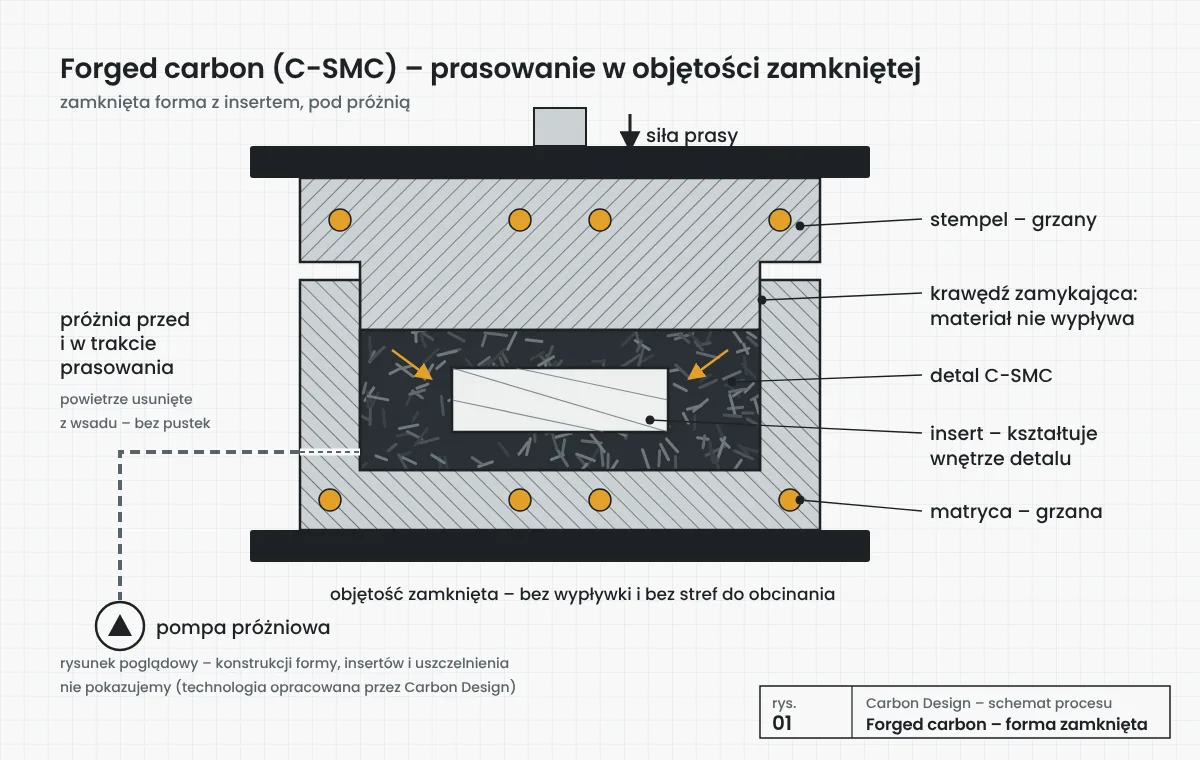
Forged carbon and classic carbon fibre are the same material – carbon fibre in resin – but in a different form. Classic carbon is made of layers of continuous-fibre fabric, forged carbon of chopped fibre bundles pressed in a mould. This difference determines the shape, the properties and the cost of the part.
Key differences
| Feature | Forged carbon (C-SMC) | Fabric laminate (prepreg) |
|---|---|---|
| Fibre form | Chopped bundles, typically 12–50 mm | Continuous fibre in a fabric or tape |
| Shapes | Complex 3D: ribs, bosses, inserts | Shapes built from plies, limited ribs |
| Properties | Quasi-isotropic in plane | Designed directionally, highest along the fibres |
| Cycle | Minutes | Hours (autoclave) |
| Mould | Heated steel mould | Composite, aluminium or steel |
| Appearance | Marbled | Fabric weave |
When to choose forged carbon
When the part has a complex 3D shape, the series is hundreds or thousands of parts a year and the part replaces machined aluminium. Forged carbon also allows hollow parts – with our method, without cutting or shortening the fibres.
When to choose a fabric laminate
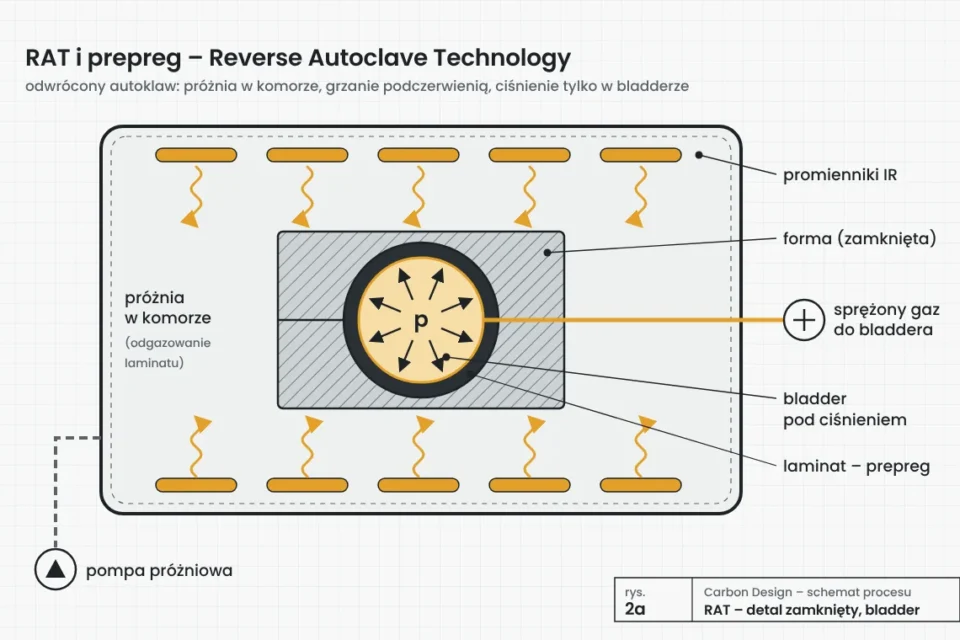
When maximum stiffness and strength in a given direction matter, the part is thin-walled and large, or the series is small. Then prepreg cured in an autoclave, with RAT or out of autoclave (OOA) is the better choice.
Questions and answers
Is forged carbon weaker than carbon fibre?
Along the fibres a continuous-fibre laminate is stiffer and stronger. Forged carbon, on the other hand, has similar properties in all in-plane directions and fills shapes that cannot be made from fabric.
Does forged carbon need to be painted?
Not always. The structure of the chopped fibres is visible without paint, but a clear coat enhances the look and protects the surface from UV.