
RAT and prepreg – Reverse Autoclave Technology
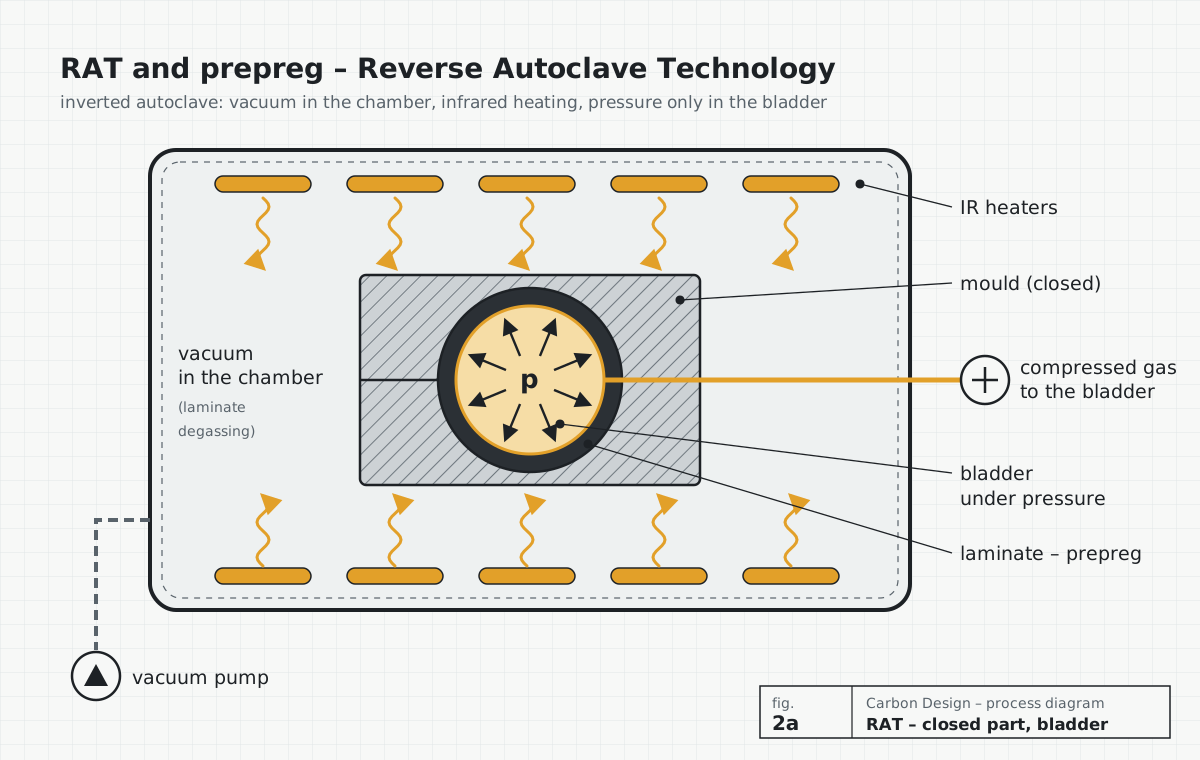
Hand layup of prepreg and curing under pressure. The lowest porosity and the highest properties. A more economical process than an autoclave. RAT, the reverse autoclave, is a way of curing composites in which the roles of pressure and vacuum are swapped. The part on its mould goes into an oven whose chamber is pumped down to vacuum. Infrared heaters heat the laminate and the mould, and a bag or bladder filled with compressed gas presses the laminate against the mould.
Key parameters
| Around the part | vacuum in the oven chamber |
| Heating | infrared (IR) heaters |
| Pressure source | pressurised bag or bladder |
| Compressed gas | only in the bag or bladder, not in the whole chamber |
| Closed parts | profiles, frames, tubes – a bladder presses from inside |
| Open parts | panels, covers – a pressurised bag bears against a lid closing the mould |
| Ovens at our plant | 3 RAT vacuum ovens |
We set the process parameters – pressure, temperature profile, cycle time – for the laminate and the part.
What you can order from us
- Prepreg profiles, frames and tubes – pressed from inside by a bladder
- Panels, covers and shells – a pressurised bag bearing against a lid
- Prepreg parts for which a vacuum bag alone does not give enough pressure
| Materials | carbon, glass and aramid prepregs |
| Typical volumes | prototypes and small series – depending on size and laminate |
| At our plant | 3 RAT vacuum ovens with infrared heating |
| For a quote send | a 3D model or drawing – or a description and sketch, the requirements and annual quantity |
How the reverse autoclave works
| Autoclave | RAT (reverse autoclave) | |
|---|---|---|
| What fills the chamber | hot compressed gas | vacuum |
| Where the pressure comes from | from outside – gas presses the vacuum bag onto the mould | from a bag or bladder filled with compressed gas |
| Where the vacuum is | under the bag, at the laminate | in the whole chamber, around the part |
| How the laminate is heated | convection – hot gas carries the heat | infrared radiation – directly onto the mould and laminate |
| Volume of compressed gas | the whole chamber | only the bag or bladder |
There is no convection in a vacuum, so heat has to reach the laminate by radiation – hence infrared heating. The energy goes into the mould and the laminate, not into large volumes of gas that an autoclave has to heat and compress together with the whole chamber.
The vacuum around the part helps to draw air and volatiles out of the laminate, and the pressure from the bag or bladder presses the plies onto the mould. In closed parts – profiles, frames, tubes – the bladder works from inside and presses the laminate against the walls of the outer mould.
Closed and open parts
In closed and hollow parts – profiles, frames, tubes – the laminate lies on the walls of a closed mould, and a bladder inside the part presses it from within (fig. 2a).
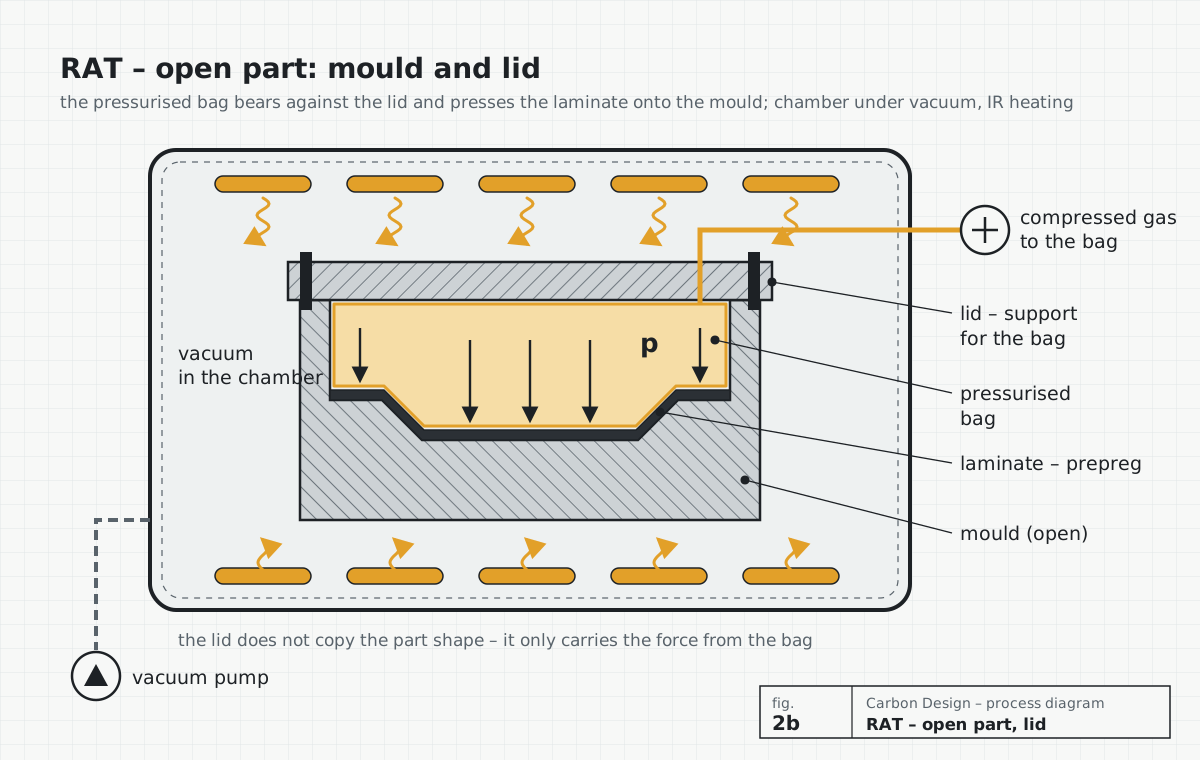
In open parts – panels, covers, shells – we lay the laminate on a single-sided mould. A simple lid closes the mould on the other side. Between the laminate and the lid there is a bag: when filled with compressed gas it bears against the lid and presses the laminate onto the mould (fig. 2b). The lid does not have to copy the shape of the part – it only carries the force from the bag, so it is simple and inexpensive.
In both variants the oven chamber is under vacuum and infrared heaters provide the heat.
RAT compared with autoclave and OOA
| Property | Autoclave | RAT | OOA – VBO prepreg |
|---|---|---|---|
| Laminate consolidation | gas overpressure in the chamber | overpressure in the bag or bladder | atmospheric pressure only (vacuum under the bag) |
| Heating | hot gas | infrared heaters | convection oven |
| Pressure vessel | the whole chamber | only the bag or bladder | none |
| Laminate degassing | vacuum under the bag | vacuum in the whole chamber | vacuum under the bag |
When to choose it
- The part needs more pressure than a vacuum bag alone gives, and an autoclave is too expensive or too small
- The part is open – a panel or cover – and can be pressed by a bag bearing against a simple lid
- The part is closed or hollow and a bladder can press the laminate from inside
- You want to heat only the mould and the laminate, not the whole chamber volume
- You want to cure prepreg without pressurising a whole chamber with gas
When another process is better
- A certified autoclave process on an existing aerospace standard is required
- The series runs to tens of thousands of parts – forged carbon or compression moulding
- A very large open part – vacuum infusion
How the RAT process runs
- Design of the laminate and the mould, including the pressure method: a bladder inside a closed part, or a bag under a lid closing the mould for an open part.
- Laying the prepreg plies on the mould and fitting the bladder, or the bag and the lid.
- Placing the set in the oven and pumping the air out of the chamber.
- Filling the bag or bladder with compressed gas and heating with infrared heaters to the temperature profile.
- Curing, cooling, demoulding, machining and laminate inspection.
Questions and answers
What is RAT (Reverse Autoclave Technology)?
RAT is a reverse autoclave: a composite curing technology in an oven whose chamber is under vacuum. Infrared heaters heat the laminate and the mould, and a bag or bladder filled with compressed gas presses the laminate onto the mould.
Why a “reverse” autoclave?
Because it swaps pressure and vacuum. In an autoclave compressed gas fills the chamber and the vacuum is under the bag. In RAT the vacuum is in the chamber and the compressed gas is in the bag or bladder.
How is RAT different from OOA with VBO prepreg?
In the VBO method only atmospheric pressure consolidates the laminate, because there is vacuum under the bag and ordinary air outside. In RAT the bag or bladder is filled with compressed gas, so the pressure can be higher, and the vacuum in the whole chamber also helps to degas the laminate.
Why infrared heating?
In a vacuum there is no air to carry heat, so the laminate and the mould are heated by radiation. Infrared heaters heat the mould and the laminate directly, without heating a large volume of gas.
Which parts are suitable for RAT?
Prepreg parts that need more pressure than a vacuum bag alone gives. Closed and hollow parts – profiles, frames, tubes – are pressed by a bladder from inside. Open parts – panels and covers – are pressed by a pressurised bag bearing against a simple lid that closes the mould. We assess a specific part from the drawing and requirements.
Other technologies
Need help choosing?
Send us a description of the part and the planned quantity – we will propose the process and explain why.
Have a drawing or just an idea? We will tell you how to make it.
Tell us what the part has to do, how many you need and what the requirements are. We will reply with a proposed process, material and next steps – with no obligation, under NDA if needed.