
Prepreg with an expanding core
We mould prepreg structures on an expanding core – for example InsituCore® by L&L Products. The core is a heat-activated material: in a closed, heated mould it foams, fills the inside of the part and presses the laminate against the mould walls from within. After curing it stays in the part as a light structural foam bonded to the laminate.
Key parameters
| Mould | closed, heated |
| Laminate consolidation | from inside – the expanding core |
| Core | foamed by heat, stays in the part |
| Autoclave, bladder | not needed |
| Typical parts | profiles, frames, arms, sandwich parts |
We choose the core type, expansion ratio and temperature profile for the laminate and the part.
What you can order from us
- Closed profiles and frames with a complex interior
- Arms and beams in which the foam supports the walls
- Sandwich parts moulded in one cycle
| Materials | carbon or glass prepreg + heat-foaming core (e.g. InsituCore®) |
| Typical volumes | chosen for the part – from a prototype |
| At our plant | closed heated moulds, ovens |
| For a quote send | a 3D model or drawing – or a description and sketch, the requirements and annual quantity |
How it works
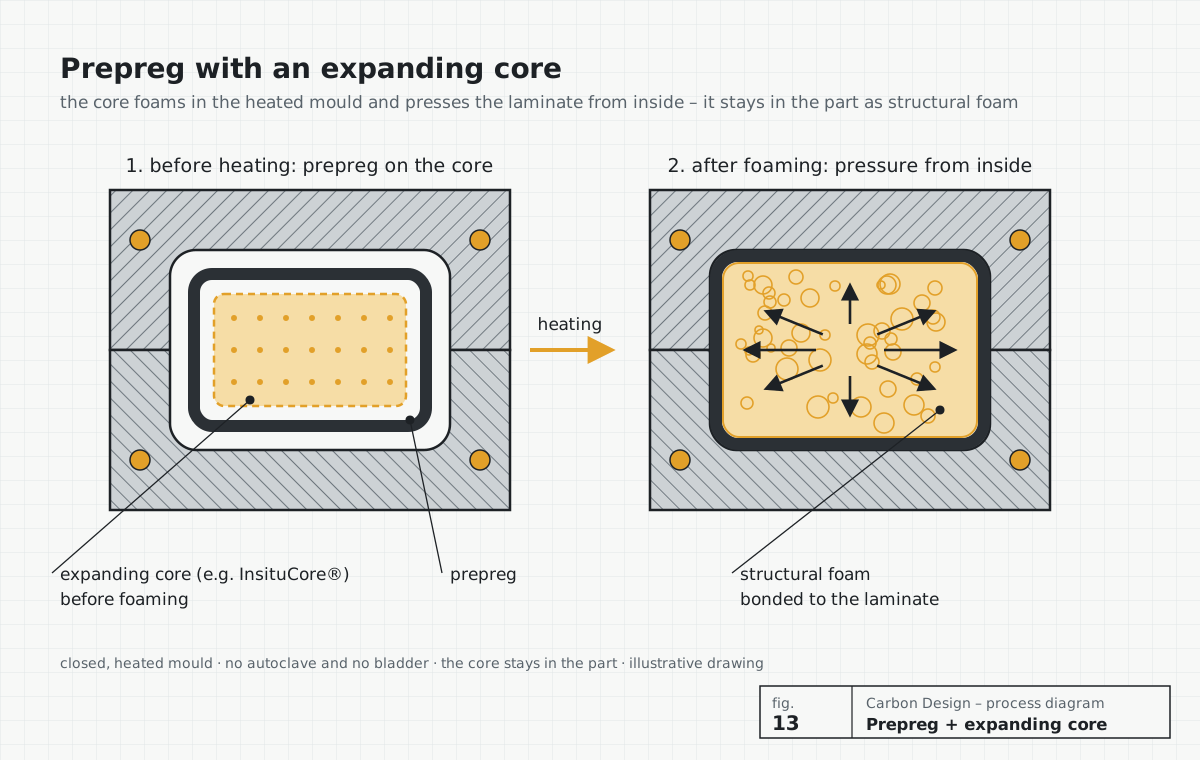
We lay prepreg plies on a core made of heat-foaming material and close the set in a mould. During heating the core material foams and increases in volume. Because the mould is closed, the growing foam builds pressure: it fills the inside of the part and presses the laminate against the mould walls, while the prepreg resin cures in the same cycle.
After cooling we remove the finished part: the mould forms the outer surface, and the foam bonded to the laminate stays inside. There is no need to bond halves or to remove a core or bladder.
| Bladder (e.g. in RAT) | Expanding core | |
|---|---|---|
| Pressure source | compressed gas in the bladder | the expanding foam of the core |
| Inside the finished part | empty – the bladder is removed | filled with structural foam |
| Complex interior shapes | limited – the bladder must come out | the core also fills hard-to-reach areas |
| Wall support | laminate only | laminate + foam supporting the walls |
When to choose it
- The part is closed and has a complex interior from which a bladder is hard to remove
- Foam inside can stiffen the walls and reduce the number of plies
- You want to form the core and bond it to the laminate in one cycle, without adhesive
- You need the vibration damping or insulation the foam provides
When another process is better
- The part must be hollow, e.g. for cables – bladder and RAT
- The lowest possible mass without filling matters – a bladder or a washout core
- Complex 3D shapes in large series – consider forged carbon
How we introduce the process
- Core selection: material type, expansion ratio and activation temperature for the prepreg resin.
- Part and laminate design taking into account how the foam works in the structure.
- Design of a closed, heated mould in NX Mold Wizard – with space for the core expansion.
- Core preparation, prepreg layup and closing the mould.
- Heating to the profile: foaming of the core and curing of the laminate in one cycle, then part inspection.
Questions and answers
What is an expanding core?
It is a heat-activated material that foams and increases in volume when heated in a mould. In a closed mould it builds pressure, fills the inside of the part and presses the laminate against the mould walls.
Does the core stay in the part?
Yes. After curing it stays as a light structural foam bonded to the laminate. It supports the walls of the part and can reduce the number of prepreg plies.
How is this different from bladder moulding?
A bladder presses the laminate with compressed gas and is removed after curing, so the part is hollow. An expanding core presses the laminate with the expanding foam and stays inside – it works well where a bladder cannot be removed.
Is an autoclave needed?
No. The core itself provides the pressure in the closed mould, so a heated mould is enough – in a press, in an oven or with its own heating.
External data sources: L&L Products – InsituCore®.
Other technologies
Need help choosing?
Send us a description of the part and the planned quantity – we will propose the process and explain why.
Have a drawing or just an idea? We will tell you how to make it.
Tell us what the part has to do, how many you need and what the requirements are. We will reply with a proposed process, material and next steps – with no obligation, under NDA if needed.