Prepreg has to be cured under pressure and at an elevated temperature. This can be done in an autoclave, in a reverse autoclave (RAT) or with one of the out-of-autoclave (OOA) methods. Each of them presses and heats the laminate differently.
The three methods in brief
| Autoclave | RAT | OOA – VBO prepreg | |
|---|---|---|---|
| Laminate pressure | Compressed gas in the whole chamber | Pressurised bag or bladder | Atmospheric pressure |
| Vacuum | Under the bag | In the whole chamber | Under the bag |
| Heating | Hot gas (convection) | Infrared heaters | Convection oven |
| Compressed gas | The whole chamber | Only the bag or bladder | None |
Autoclave
The standard for critical aerospace parts: typically 3–7 bar and 120–180 °C, porosity below 1%. The drawbacks are the cost of the equipment, the limit on part size and the energy needed to heat and pressurise the whole chamber.
RAT – the reverse autoclave
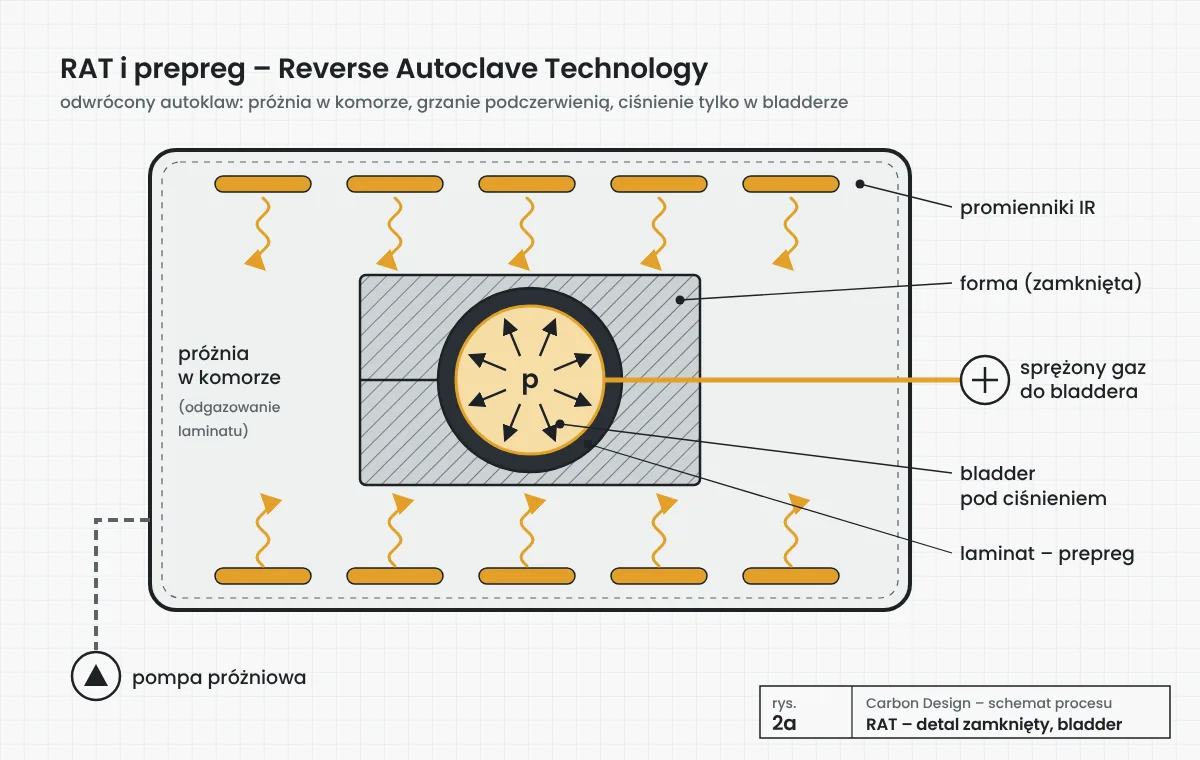
In RAT (Reverse Autoclave Technology) the roles of pressure and vacuum are swapped. The oven chamber is under vacuum, infrared heaters heat the laminate and the mould, and the pressure comes from a bag or bladder filled with compressed gas. Only the bag is pressurised, and the vacuum around the part helps to degas the laminate.
Out-of-autoclave methods
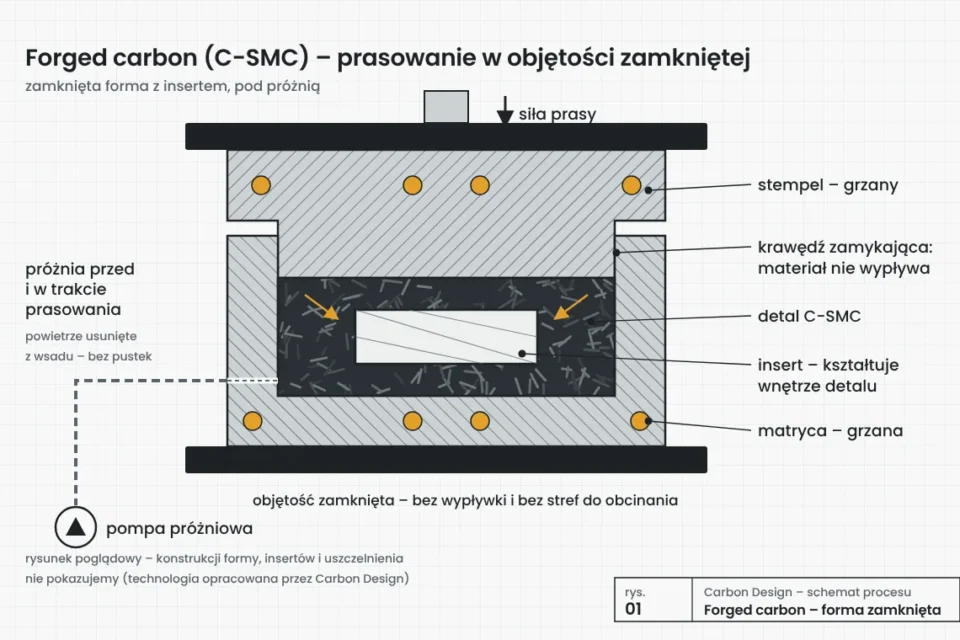
OOA methods do not use an autoclave: VBO prepreg is cured under a bag alone in an oven, PCM in a press and SQRTM in a closed mould with resin injection. With VBO the only pressure is atmospheric pressure, so porosity is usually slightly higher than in an autoclave.
How to choose
- A certified aerospace process on an existing standard – autoclave
- More pressure than a bag alone, without pressurising the whole chamber – RAT
- A large part and a low investment cost – OOA with VBO prepreg
- A medium series and a short cycle – PCM or SQRTM